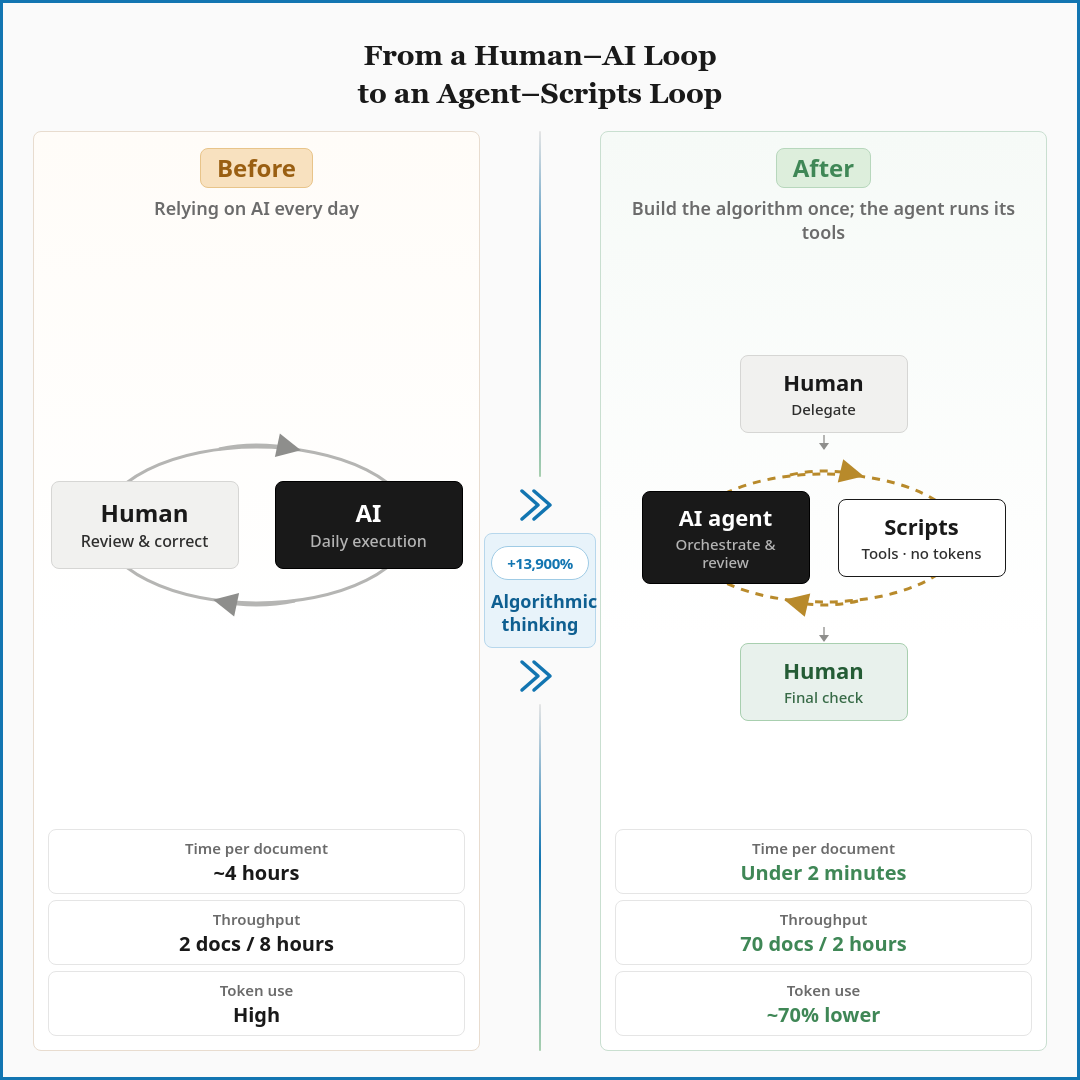
This morning I measured the productivity gap on one of my recurring tasks over four months:
A gradual 13,900% increase in productivity across four months of intermittent work.
I built an Arabic legal chatbot for a company so it answers from a controlled database of reviewed legal texts, without searching the open web or inventing answers.
The hardest part of all the intelligence in that chatbot is preparing the data so it can find the right material quickly when visitors ask questions.
In practice, the legislation arrives in many shapes: text files with different extensions, or links to web pages, and every statute has a different structure and layout.
At first I assumed the mess would force me to prepare every document by hand to feed the knowledge base the bot draws from.
About four months ago, preparing two statutes took a full day of manual work (about four hours per document). I used AI in many of the steps, but I still had to review and hand-edit heavily because edge cases were everywhere.
This morning I prepared 70 statutes in under two hours of work (about two minutes per document).
How?
Over those four months I built several tools to improve and speed up this exhausting process:
- A set of integrated Python programs that detect the document type and structure, normalize it into the pattern I need, catch common errors and gaps, and generate a report describing the output document, its structure, and the likelihood of unexpected errors (for example: the document has 40 legal articles | possible numbering error between articles 30–35 (lines 500–713) | possible missing article at the start of the document (line 5) | possible unusual structure (lines 20, 124, 461))
- A documented procedure Claude can follow so it runs those Python programs as tools, receives the completion report with those alerts and line numbers, knows how to inspect those lines and handle different cases until we reach the standard form, and finally shares a short report on how many articles were processed and which fixes still look uncertain and need my manual review.
Why did it take me four months to reach this comfortable, near-automated solution?
Because Claude’s intelligence needed time to improve enough? ❌
Because my skill at using Claude needed time to improve enough? ❌
Because my skill at algorithmic thinking needed that time? ✅
The improvement did not come from better AI or from using more of it. It came from understanding what non-intelligent programming can do (code with no AI in the loop).
What changed was my gradual discovery that much of what looks random in this process can be turned into a sequential, logical, decisive algorithm that can make decisions that look smart on its own, without calling an AI model and without spending any tokens.
This is the kind of automation your company should aim for.
Instead of depending on AI being available to run the task every day, use AI to build the algorithm and the program that can run the task 90% of the time, and leave the remaining 10% to you and the AI.
Imagine the difference in cost, speed, and independence you would get if you could do that.
Impossible?
That is what people who have never tried programming, and what it can do, will never know.
Before you need a program or a smart agent, you need an algorithmic thinker who can turn your problem and your work into precise algorithms, then help you decide which steps to code, which to hand to AI, and which to keep with your human team.