Overview
Tammey is a small consultancy that identifies as a social enterprise. By the time I worked on its knowledge base, the team had already accumulated years of projects, proposals, deliverables, partners, collaborators, countries, themes of work, and hard-won lessons. The problem was not that this history was undocumented. The problem was that it lived across folders, Excel sheets, reports, and scattered documents that were difficult to navigate as a living body of knowledge.
Kamel, Tammey’s lead and CVO, used to ask interns to maintain parts of that history in folders and spreadsheets. That created a static archive, not a knowledge system. It could store information, but it could not help the team move through Tammey’s memory by project, country, theme, partner, collaborator, deliverable, or lesson learned. Knowledge was technically present, but practically trapped.
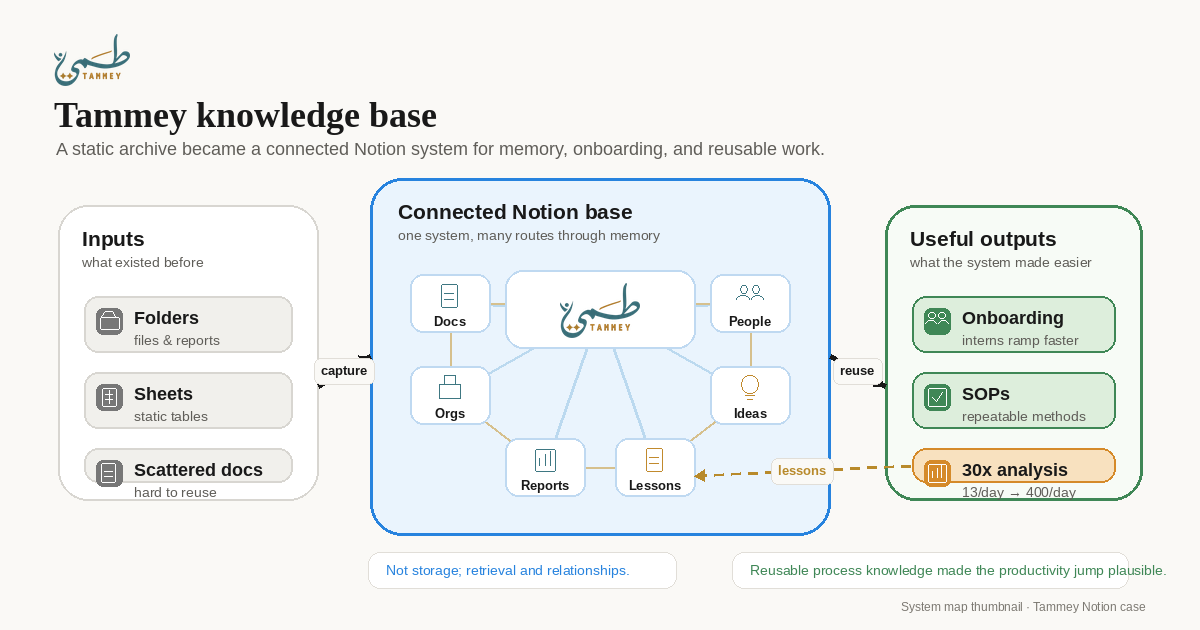
I rebuilt that history in Notion as an interconnected knowledge base. The system included databases for projects, people, organizations, countries, topics of interest to Tammey, proposals, deliverables, and a resource library for outputs created during and between projects. These databases were connected into a dense knowledge graph that let Kamel and the team explore Tammey’s work in multiple nonlinear ways and rediscover reusable assets and interesting connections.
The challenge
Tammey’s work crossed many layers at once: youth development, research, strategy, facilitation, institutional development, and knowledge production. A single project could involve multiple partners, countries, collaborators, research tools, reports, proposals, lessons learned, and follow-up opportunities. A folder structure could not represent those relationships well.
The old setup had three limits:
- Static storage: folders and spreadsheets could list files, but they did not reveal the relationships between them.
- Fragile maintenance: keeping institutional memory depended on interns or individual team members updating disconnected records.
- Weak retrieval: the team could not easily ask, “What have we done on this topic?”, “Which partners were involved?”, “What did we learn?”, or “Which deliverables can we reuse?”
At the time, AI tools were still limited. But I anticipated that AI would eventually become useful inside organized knowledge environments. That meant the knowledge base had to be designed before AI became mature: clean entities, consistent links, reusable categories, and enough structure for future retrieval.
What I built
I designed the base around the actual shape of Tammey’s work, not around a generic template.
Core databases included:
- Projects: the main timeline of Tammey’s work and engagements.
- People: collaborators, consultants, researchers, and important contacts.
- Organizations: partners, clients, funders, and stakeholder institutions.
- Countries: geographic context for projects and partners.
- Topics: themes of interest to Tammey, used to categorize projects, organizations, people, and resources.
- Resource library: proposals, reports, tools, deliverables, templates, and outputs created during or between projects.
- Lessons learned: reusable reflections from projects, research processes, operational mistakes, and team decisions.
The value came from the relations between these databases. A project could point to its partners, countries, topics, collaborators, deliverables, proposals, and lessons learned. A topic could become a doorway into all projects, people, and resources connected to it. A partner could be understood not as a name in a spreadsheet, but as part of a history of interactions, outputs, and opportunities.
From archive to operating layer
The base later expanded beyond institutional memory. As we discovered, optimized, and repeated workflows, I documented them as SOPs and onboarding material inside Notion.
This included workflows such as:
- Research design.
- Questionnaire data analysis.
- Report development.
- Tech accounts management.
- Document formatting and templates.
- Onboarding packages for interns, consultants, and collaborators.
- Internal practices for capturing and reusing lessons learned.
This changed the base from a reference archive into an operating layer. New team members could be onboarded into the logic of Tammey’s work, not just given a folder of files. The team could reuse its own expertise instead of rediscovering the same mistakes from scratch.
Why Notion mattered
Notion mattered because it could hold different kinds of knowledge in one connected place: structured data, documents, files, SOPs, links, notes, deliverables, and reflections. More importantly, it allowed those pieces to be cross-referenced without forcing the team into one rigid hierarchy.
The same item could be found through a project, a country, a partner, a topic, a person, or a resource type. That nonlinear navigation matched how real institutional memory works. It also made the base ready for AI-assisted retrieval once Notion AI and similar tools became more capable.
Impact
The strongest result was not a cleaner archive. It was operational reuse.
The same team later scaled its work roughly threefold, and the questionnaire-analysis workflow shows the productivity leap clearly. In 2020, analyzing 800 questionnaires and creating a Power BI report took around two months; assuming roughly 60 days, that is about 13 responses per day. In 2021, the team analyzed 2,000 questionnaires in five days and produced an even better Power BI report; about 400 responses per day, or roughly 30x the throughput.
That leap was not because Notion magically did the work. It happened because the process had been documented, improved, cross-referenced, and made reusable: the mistakes to avoid, the analysis steps, the reporting patterns, and the lessons learned were all easier to find and apply.
Kamel’s shorthand for the role captured the work well:
“We call him our knowledge engineer.”
What this case proves
This project shows how a Notion workspace can become more than a productivity tool. When designed around the real relationships inside an organization’s work, it can become institutional memory, onboarding infrastructure, operational documentation, and a foundation for future AI use.
For Tammey, the knowledge base turned years of scattered history into a living system the team could navigate, reuse, and build on.